
Appalachian poet, novelist Ron Rash headlines literary festival at ETSU
By Ophelia Wagner
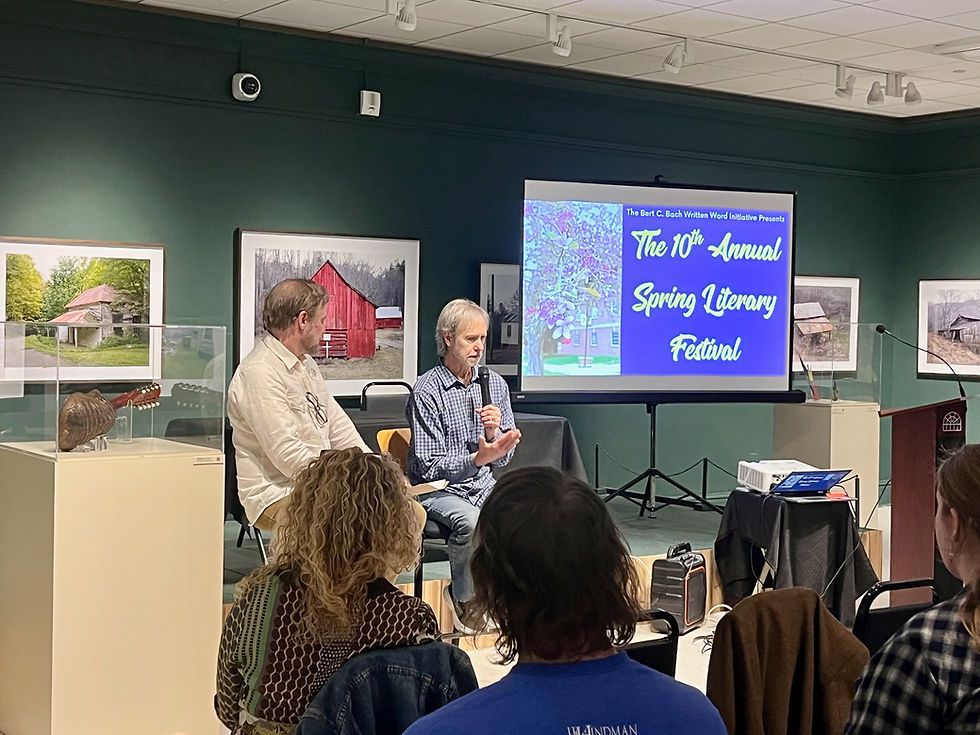
Acclaimed Appalachian poet and novelist Ron Rash visited East Tennessee State University in April as the keynote speaker for The Bert C. Bach Written Word Initiative’s 10th Annual Spring Literary Festival at ETSU on April 21-22. Hosted by ETSU’s Literature and Language department, the festival welcomed writers such as Rose McLarney, Juan Martinez, and Nickole Brown for poetry and prose readings and public conversations.
Rash has authored 21 books, many of which revolve around his home of Southern Appalachia, including his most recent novel, The Caretaker, which focuses on Blowing Rock, North Carolina, during the Korean War. As the keynote speaker, he participated in two events: a conversation with Jesse Graves, ETSU’s Poet-in-Residence and director of the Bert C. Bach Written Word Initiative; and a reading during the festival’s final evening, where Rash called Johnson City “the epicenter of Appalachian literature.”
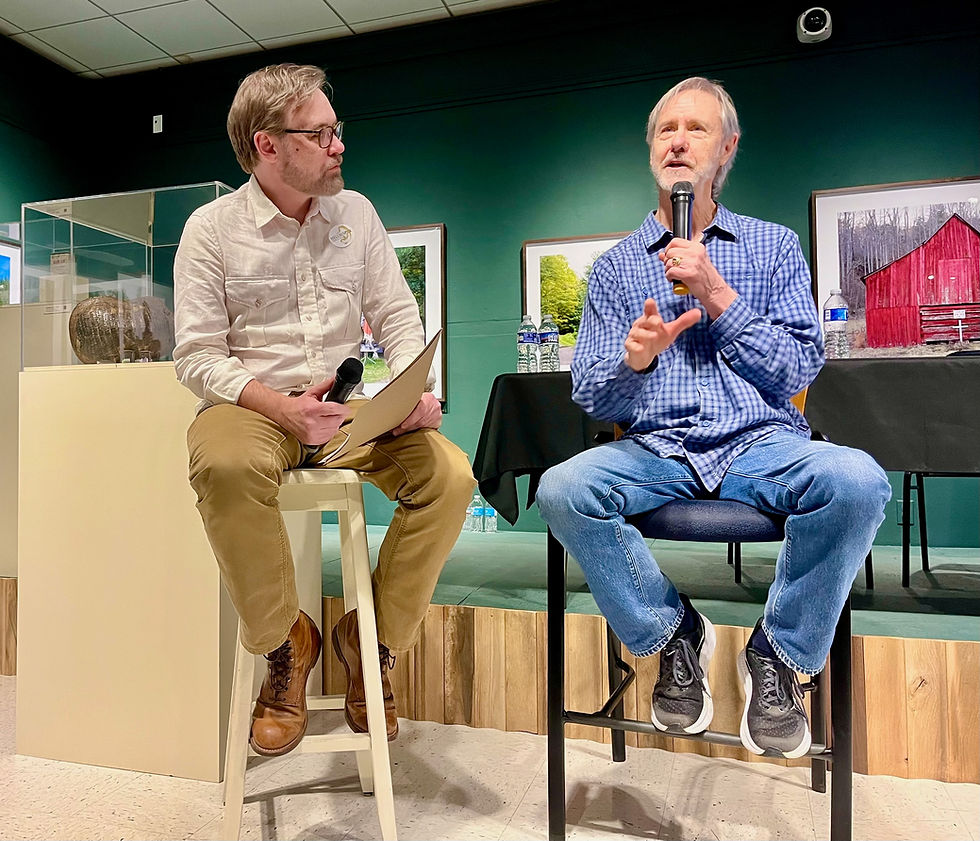
During an hourlong conversation between Graves and Rash on April 22 at ETSU’s Reece Museum, Graves — a longtime fan and colleague of Rash’s — covered everything from literary styles and writing rituals to the connections between death and salamanders. Graves said that choosing Rash as the keynote speaker for the event’s 10th anniversary was a way to honor the festival’s beginnings.
“We wanted some home cooking,” Graves said, “a writer who could show us the world we live in every day in ways that enlarge and expand our experience of it. We needed the writer whose work transcends any category of Appalachian literature in the same way that Seamus Heaney’s poems move beyond Irish literature. They are grounded in the place and could not be mistaken as coming from anywhere else, and yet readers from everywhere can relate to the deep human experiences they evoke. We needed Ron Rash.”
Below are excerpts from the conversation between Graves and Rash.
Many of your characters have a spiritual yearning. I’m thinking back to Above the Waterfall, but other books as well. What is that spiritual quest giving you room to explore in your writing?
Well, I take it all the way back to my childhood. I spent so much time on my grandmother’s farm near Boone. Actually, one aspect of this new novel, The Caretaker, was that it was set on my grandparents’ farm, and there was a church and a cemetery right above the farm. Sometimes, a flower bouquet, a wreath, would be blown over on our land after a storm. As a child, I would be sent up there and put it back over. There was just a barbed wire fence between the cemetery and our land. I was taught to do this very reverently. And I can remember, even as a child, that moment when I would put, from our land into this kind of, land of the non-living. But there was always nothing frightening about that. I had relatives buried in that graveyard. So, I was already kind of getting used to the sense that it mattered to the dead.
I loved to catch salamanders and crayfish in streams, but my grandmother would never let me do it near the spring house. What I started to realize later was that it was because of a folk belief of hers that they were the guardian spirits of the water. And that makes ecological sense as well because if the salamanders are alive that means the water is pure.
So, I mean, there’s always this sense of mystery and all the folklore. I’ve always thought that I want to live in a world of mystery. I want to live in a world where there’s something out there transcendent, which I do believe. In a way, it’s almost as if we cut ourselves off from that. But it’s there whether we want to acknowledge it or not. There’s a Welsh poet named Bobby Jones who said “It is mystery that gives us an endless comfort.”
How do you decide which pieces you can keep building on?
I hope it doesn’t sound overly pretentious, but I see my work as a quilt. So, the poems, the stories, the novels, all of this, to me, is one thing. It’s almost like you’re cutting different pieces and you’re showing them in a different light. We both revere Robert Morgan and he certainly led me toward this.
I think that is maybe a Southern writer trait, but especially an Appalachian writer trait. What does each genre of writing allow you to do that the others don’t? Or, in other words, what can you accomplish in a short story that you can’t fully do in a poem, or the same for a novel versus a short story?
Well, the poem is a Pegasus. The short story is a gazelle — no, that’s too fast. It’s a bear. The novel, I mean, as far as a creation, it’s a mule. You just put the blinders on, and you go up one row and another, and you can’t look up. You just go. They all have their challenges. I think, certainly with poetry, there are really intense sound challenges. I’m interested in the stitching of sounds. The line breaks, knowing how to do that, that’s very complicated. But for me, the short story’s the hardest. I take everything I’ve learned from poetry and everything I’ve learned from writing a novel, and I try to get it into a short story. It’s almost like working a poem, because it’s so intense and you’re not wanting to waste a line. It is so hard to do it well, but when you do it, it’s a kind of miracle.
I mean, a story such as Flannery O’Connor’s A Good Man’s Hard to Find, I mean, that’s an incredible story. You cannot take a line out of that story. And that’s miraculous, but the novel allows you a world. You’re able to create a world, and there’s a great satisfaction in that.
I’ve always been grateful that several years ago, you recommended the French writer, Jean Giono, to me, which was a revelation. Are there other writers from faraway places, maybe under read or underappreciated, that have inspired or guided some part of your writing?
Oh yeah, and I think that’s for the younger people in the audience and younger writers, that’s so important. Don’t just read about the people in your region. You need to read from around the world, and because you’ll gain so much more. Marquez was important to me early on. Certainly, Things Fall Apart, I remember the sense of place in that novel. I am drawn to some of the French writers, but there’s a Swiss writer that I really feel an intense kinship with. His name’s (Charles) Ramuz, and he writes about the mountains. In his work, the mountains are a living entity. It’s really interesting because I think there is a difference in different mountain cultures.
One thing that’s been interesting is my books have been translated now into other countries. And very often, it’s the people in the mountainous areas of the countries that respond the strongest. One thought I have, that I’ve kind of run with is that landscape is destiny. The landscape you’re born into can really shape how you perceive the world. I really believe that. I think with Appalachian people, sometimes I’ve also sensed a kind of fatalism. The mountains are constantly reminding you how small and insignificant your life is.
Ophelia Wagner is a student in the Master’s in Appalachian Studies program at East Tennessee State University, and an assistant editor for Appalachian Places.


Comments