
Mobile medicine on mountain roads
St. Mary's Health Wagon brings health care
to remote areas of Southwest Virginia

By Iris Castillo
On the narrow, winding roads of Southwest Virginia, distance has never been measured in miles alone. Here, distance is felt in whether a car starts on a cold morning, or whether a neighbor can afford to take time off work to drive someone to an appointment three counties away. In central Appalachia, a mile “as the crow flies” can take hours to traverse by road. Geography has always shaped access to health care.
More than 40 years ago, one woman decided that if people could not reach care, care would have to reach them.

Teresa Owens Tyson, Health Wagon president and Family Nurse Practitioner, describes the early days of working alongside Sister Bernadette Kenny, known to nearly everyone as Sister Bernie, with a clarity that has been carried forward through decades of telling. Tyson recalled Sister Bernie traveling the back roads of the coalfields in her Volkswagen Beetle, carrying basic medical supplies and a conviction that health care should not depend on circumstance. According to Tyson, Sister Bernie went where the pavement ended and directly into holler communities.
What began as informal service eventually took shape. In 1980, Sister Bernie formalized her work into what would become St. Mary’s Health Wagon, one of the nation’s earliest mobile free clinics. From the start, the work was about showing up — and Sister Bernie’s example led many other providers and volunteers to do just that.
“Every time I’m taking care of someone with black lung, I’m taking care of my dad,” said Ashley Stanley, a Health Wagon Family Nurse Practitioner who started out shadowing Sister Bernie as a teenager.
Serving in Appalachia
The counties served by the Health Wagon — Dickenson, Buchanan, Lee, Russell, Scott, Wise, and the City of Norton — span more than 1,700 square miles of mountainous terrain. On a map, the distances appear manageable. On the ground, they rarely are.

Public transportation is virtually nonexistent. Unlike other regions of Virginia where bus systems and regional transit options are available, many Appalachian communities operate without any formal public transportation at all. Missed appointments are often the result of the reality that one working vehicle must serve an entire household.
Economic hardship compounds the geography. The long decline of coal mining and tobacco farming has reshaped the region, leaving behind high unemployment, low household incomes, and limited access to employer-sponsored insurance. Some patients are uninsured. Others carry plans with deductibles and co-pays that place routine care out of reach.
Some eventually visit Health Wagon clinics having delayed seeing a provider for years — not because symptoms were minor, but because the cost of a diagnosis felt more frightening than the symptoms themselves. For many families, seeking care carries the risk of destabilizing everything from rent and utilities to food.
Even when services are available, access is not guaranteed. Specialty clinics fill quickly. There are days when the need outpaces what can reasonably be provided. Difficult decisions must be made about who can be seen and who must wait.
Health care here is rarely about a single visit. It is about continuity in a region where systems have come and gone, and trust has eroded through experience.
Response to reality
In remote, mountainous and economically depressed areas, making it to a doctor’s appointment can require planning, favors, and time off work. Mobile clinics emerged not as a preferred model, but as a practical response to these realities. Parking outside grocery stores, churches, workplaces, and community centers, care arrived where people already were. Appointments happened between shifts or errands where people had a moment to spare.
Mobile care is not a complete solution. It cannot replace stable infrastructure or address every need. Permanent clinics require capital investment, specialized staff, and ongoing operating funds that are difficult to sustain in economically distressed regions. In that context, mobility becomes less a stopgap than a way to maintain access at all. Mobile clinics may be limited and contingent, but often the only feasible option in a landscape shaped by distance and scarcity.
At a recent outreach clinic, a 53-year-old man who had recently moved from Texas to be near family stopped in to be seen after being encouraged to do so. “I’ve got glasses. I’ve got a primary care physician. I’ve got a psychiatrist. I’ve got medication,” he said after his first appointment. “I got more than I ever imagined here, and I am very thankful for that.”
Tapping tradition
Care coordination in the region reflects an Appalachian tradition of mutual aid, with local organizations working collaboratively to provide culturally responsive care. Health is understood here as inseparable from daily realities. Food insecurity, housing instability, trauma, and isolation can shape outcomes long before a patient ever reaches an exam room.
Within that context, healing often takes forms that extend beyond clinical intervention alone. Joseph F. Smiddy, a retired pulmonologist and longtime Medical Director of the Health Wagon, talks about trust as the foundation of care. One thing he uses to help establish trust is music.
“Music is a bond. A bond is trust, Smiddy said. “Trust in medicine starts a plan. Sharing a song offers a measure of human kindness. And that’s quality health care.”
Outreach and volunteerism
Large-scale outreach involving medical care in the region, according to Tyson, began during the late 1990s at the VA-KY Fairgrounds in Wise County, which became the site of one of the largest medical outreaches in the country. What is now known as Move Mountains Medical Mission grew out of the Remote Area Medical (RAM) Wise Health Expedition, founded in 1999. RAM’s bold experiment became a model that showed how collaborative, volunteer-driven care can function at scale.

In its peak years, the RAM event unfolded over three days and drew thousands of patients, some camping overnight, to receive free medical, dental, vision, diagnostic, and veterinary care. They were met by hundreds of volunteers from across the nation. Physicians, dentists, nurses, specialists, technicians, and students representing a wide range of disciplines and training programs immersed themselves in the work. Medical schools, dental schools, nursing programs, and allied health institutions returned year after year, drawn by the opportunity to serve and to learn.
Heidi Lang, a pre-health professions advisor at Saginaw Valley State University, brings undergrad pre-medical, pre-dental, and pre-vet students to volunteer at these outreach events. “I do my best to prepare the students for what it will be like,” she said, “but until you actually meet the people who are struggling and have these incredible health needs, you don’t know what you don’t know. …The most important thing to me is we treat everyone with dignity and respect. I love this organization. I’m so empowered by what they do.”
Dova Koretsky, a student at Wellesley College in Wellesley, Massachusetts, discovered the Health Wagon while exploring summer internships and after watching a 2014 CBS News report aboutthe nonprofit on “60 Minutes.”
“Never let a destination keep you from doing something that you want to do,” Koretsky said. “I definitely was a little bit nervous going into it, but sometimes you have to step out of your comfort zone to find growth. … So go try out that new place. It will welcome you.”
Shared missions
The work of follow-up has increasingly shifted to the Health Wagon’s stationary clinics. That transition has been supported in part by students who spend extended time in the region.

Dr. John S. Culp, professor of Family Medicine at East Tennessee State University’s (ETSU) Quillen College of Medicine, said the increased student involvement from ETSU is the result of a natural paring with the Health Wagon spanning more than 30 years. The university’s mission and values statement includes a commitment to honor and preserve “the rich heritage of Southern Appalachia through distinctive education, research, and service programs.” The mission of ETSU’s College of Medicine is to produce physicians “with an interest in primary care, to practice in underserved rural communities.” The school is “dedicated to the improvement of health care in Northeast Tennessee and the surrounding Appalachian Region.”

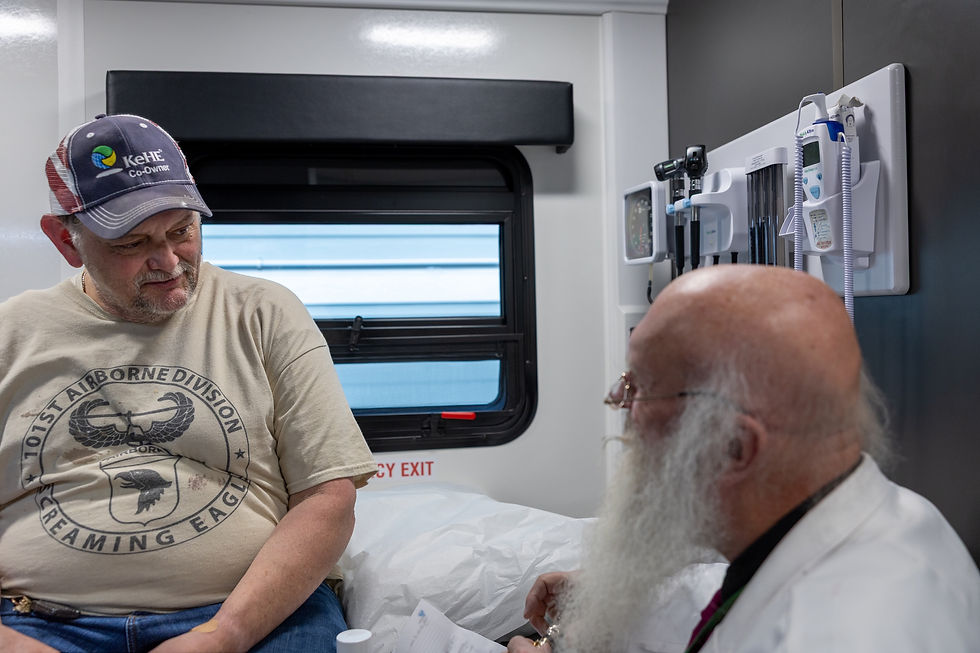
Culp said ETSU’s collaboration with the Health Wagon includes high-volume clinic days during which 10-12 medical students take active roles in patient care under supervision, as well as extended placements that allow students to remain in local clinics for weeks at a time.
“This is a great experience for the students,” Culp said. “It’s exciting to be working in the community. They see a wide range of conditions, primarily through screenings, and they’re often able to identify issues people may not have known about. From there, we can help connect patients to primary care. People come in to take advantage of the free labs and services, and the students consistently find the work meaningful.”
That continuity is reflected in how students experience their time in the region. During the STRONG ACC Regional Symposium held this past Fall at the Delta Hotel in Bristol, Virginia, Christian Blazer, a fourth-year medical student from ETSU, spoke about his clinical rotation.
“My time at the Health Wagon was a real pleasure,” Blazer said. “It reminded me a lot of home, and that connection made me feel deeply connected to my patients. I came away from the rotation with more confidence and valuable experience, and I feel proud that I was able to play a role in ensuring patients had positive experiences and received good care.”
Expanded care
As the Health Wagon matured, its work expanded beyond primary care alone.
The opening of a dental clinic in 2023 addressed one of the region’s most persistent unmet needs. Untreated dental disease remains a leading cause of pain and preventable emergency visits. Even with expanded services, waiting lists persist.
A charitable pharmacy followed in the summer of 2024, building on decades of medication assistance. Dr. Shamly Abdelfattah, Associate Professor at the Appalachian College of Pharmacy, and a 25-year Health Wagon volunteer, said St. Mary’s Pharmacy “will make people’s lives better and save lives daily for the uninsured community.”
Jennifer Hammons, describes herself as a “homegrown pharmacist” with deep roots in the Health Wagon community. She completed her clinicals at the Health Wagon and knew it was where she wanted to serve.
“My husband is a type 1 diabetic,” she said. “The Health Wagon helped him get insulin for many years, and I know they saved his life.”

Care has now also extended to animals. According to Tyson, the expansion of animal care grew out of years of coordinated veterinary outreach, including missions conducted since 2017 in collaboration with the U.S. Department of Defense Innovative Readiness Training (IRT) program and volunteer veterinarians. Those efforts provided thousands of no-cost procedures in Appalachia.
For local animal welfare leaders, the shift to a permanent clinic addresses an urgent gap. “We are in desperate need of this,” Beverly Grigsby, Director of Animal Control for the Wise County Animal Shelter, said “We are so overwhelmed, and all our counties are struggling so bad. With this clinic, it will be easier to get dogs and cats fixed locally.”
Living Legacy
Since 1980, St. Mary’s Health Wagon has grown into a complex system of care that started with one woman driving mountain roads. Its legacy is reflected in the stories patients choose to share. It is present in the woman in her 30s who came through the clinic doors after years without dental care, making the difficult decision to have teeth extracted and be fitted for dentures.
It’s in the quadriplegic man whose insurance covers only nine medical rides a year, and whose care now comes to him at his home.
And it appears in the child who brought a stuffed animal to an appointment, asking for a checkup and learning, by example, what care looks like.
Each of them is a patient who found their way to care when other paths were closed.
Iris Castillo holds a master of public policy degree from George Mason University Schar School of Policy and Government. She works in development for St. Mary’s Health Wagon with a focus on strengthening community-based systems that support underserved areas across central Appalachia.


Comments