
Nashville/Appalachia singer songwriter Thomm Jutz on place and purpose

By Becky Pendergraft Parsons
The office of Grammy-nominated songwriter, artist, and educator Thomm Jutz is unassuming. Inside Belmont University’s Mike Curb College of Entertainment and Music Business building on Nashville’s Music Row, a guitar leans against the windowsill. His Master of Arts in Appalachian Studies degree hangs behind a modest desk outfitted with a computer and two studio speakers. The room is spare, functional, and revealing: Jutz prioritizes music and connection.

“To me, Nashville is home because so much has happened here that is real to me,” he said. “When I feel good about myself, it’s not because I was nominated for a Grammy. I feel good because I did work that’s valuable to me and connected to this place.”
That outlook has guided a remarkably wide-ranging career. Jutz has toured with artists including Nanci Griffith, Mary Gauthier, David Olney, and Kim Richey. His songs have been recorded by John Prine, Del McCoury, The SteelDrivers, and Billy Strings, while his work has appeared in more than 250 film and television placements worldwide. He has produced albums for Bill Anderson, Mac Wiseman, Todd Snider, and Griffith, among many others.
His own catalog has earned equal recognition. Jutz has written seven No. 1 bluegrass songs, was named the International Bluegrass Music Association’s 2021 Songwriter of the Year, and earned a Grammy nomination for To Live in Two Worlds, Volume 1. A native of Germany, Jutz became the first immigrant recognized by the Recording Academy in the Best Bluegrass Album category. Solidifying his place in history, the Country Music Hall of Fame and Museum featured Jutz in its “American Currents” exhibit, which ran from 2022 to 2023.
Accolades are only part of the story. Jutz speaks less about achievement than place. He celebrates where a song comes from, what a landscape gives a person, and how belonging can be built across borders.
Appalachian Longing
Jutz grew up near the French border and Rhine River in Germany’s Black Forest, which resembles southern Appalachia.
“It reminds me a lot of western North Carolina and East Tennessee because of the shape of the hills,” he said. “When I’m in Appalachia, sometimes it reminds me of the Black Forest. And in the Black Forest, it reminds me of Appalachia. So, I’m sort of caught in between.”

That sense of dual belonging began early. At age 11, Jutz saw country artist Bobby Bare on television.
“That changed my life,” he said.
Soon after, he bought Doc and Merle Watson’s Down South, drawn first by the album’s cover image of two musicians seated on the porch of a country store.
“Then a whole musical universe started to unfold,” he said. Through Watson came Jerry Douglas, Ricky Skaggs, Tony Rice, Norman Blake, and countless others. “It was wave after wave.”
After years of longing to write and perform country and folk music professionally, Jutz immigrated to the United States in 2003.

“It was not a running away,” he said. “It was a running toward something else. Something in your soul calls you to a place, and you can accept the call or refuse to hear it. Either way, you’re going to pay a price.”
Once in America, he found many of his bluegrass peers had roots in Appalachia. Visits to East Tennessee and western North Carolina deepened the connection.
“I fell in love with the place,” he said.
Jutz wrote one album, and then a second, with Appalachian Bluegrass artist Mac Wiseman. The Virginia native taught Jutz about the tenacity of Appalachians and how they have used community and music to survive hard times.
“(Wiseman) grew up during the Great Depression in southwestern Virginia as a polio survivor,” Jutz said. “I heard the power of the poverty of Appalachia firsthand. It was literally like getting it from the horse’s mouth of somebody who lived in the early 1930s and remembers being a child listening to the radio. Being laid up with polio for a whole summer and hearing Jimmie Rodgers on the radio and Vernon Dalhart.”
Writing Grounds
That fascination eventually became formal study. When Belmont University approached Jutz about teaching, he needed a master’s degree to accept the role. He enrolled in East Tennessee State University’s Appalachian Studies program in Johnson City.
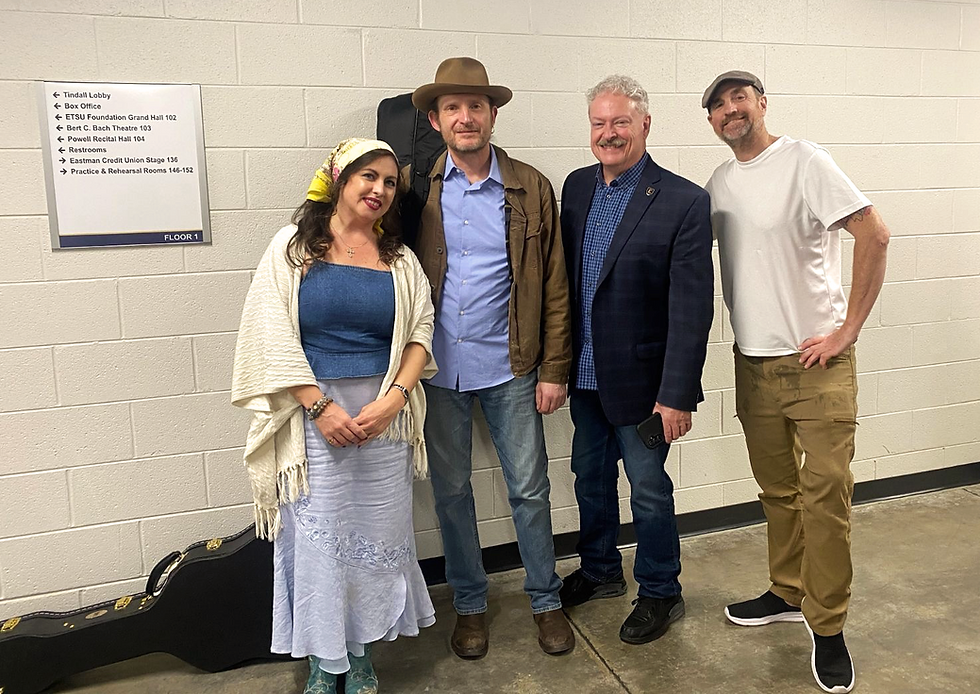
There, he continued blending scholarship with songwriting. Jutz spent a semester immersing himself in the history and culture of the nearby railroad town of Erwin, Tennessee. Inspired, Jutz tapped his friend and frequent collaborator, Tim Stafford, a Grammy-winning bluegrass artist and ETSU alumni who also teaches in the university’s renowned Bluegrass, Old-Time and Roots Music program. The pair wrote “Railroad Town Without a Train,” which follows the closure of Erwin’s longtime rail yard and its impact on the people who were left behind.
The tune is one of over 100 songs the two have written together, including duet projects Wall Dogs (2024), Lost Voices (2023), and multiple singles. Jutz has also produced for Stafford’s bluegrass band Blue Highway.
“Railroad Town Without a Train” was included in a presentation to the Appalachian Studies Association’s annual conference. It went on to be cut by Jr Williams and reached No. 1 on the Bluegrass Today chart.
Jutz’s master’s thesis examined how a sense of place shaped 20th-century folk, bluegrass, Americana, and country songwriters through the work of influential musician and songwriter Norman Blake. While not intended to be a definitive biography on Blake, the thesis discusses how his songwriting was influenced by the rural area around Sulphur Springs, Georgia, where Blake has spent his life.
“I’m inspired by somebody like Norman Blake, who found material for a full artistic life by living in the same place his entire life, being nurtured by and writing about that place,” Jutz said.
For Jutz, place is both literal and philosophical.
“Place is something that can be put on the map, but it can also be taken off the map, and the place is still there.”

That idea informs the way he teaches inside Belmont’s campus extension, where students walk daily through one of the most storied blocks in American recording history.
His office and classrooms are located not on Belmont’s main campus, but at 34 Music Square East — known in Nashville and beyond as Music Row. The building faces the headquarters of the Country Music Association and houses Columbia Studio A, where artists such as Bob Dylan, Johnny Cash, Patsy Cline, George Jones, and Loretta Lynn have recorded, and sits just down the block from Warner Records. Step outside the front doors and the roofline of historic RCA Studio A comes into view, where Elvis Presley, Dolly Parton, The Beach Boys, Tony Bennett, Kacey Musgraves, and Chris Stapleton all recorded landmark releases.
“As it relates to Nashville, I tell my students: look, this is exciting,” Jutz said. “We’re right here in the heart of music. Do you know what that means? Do you know how lucky we are to be here?”
Uncertain Forces
Jutz often encourages young songwriters to measure their worth by more than commercial success, especially in a moment when streaming economics and artificial intelligence have unsettled creative careers.
“I feel a sense of responsibility because I’ve been welcomed with open arms here,” he said “So, I want to pass on some of what I’ve learned to young artists.”
He is less concerned with competition than with young artists giving up.
“I especially want to tell them that the saddest thing you can do is stop writing songs, stories, painting, dancing, just because it doesn’t provide a clear economic outcome. Well, guess what? Nothing does anymore.”

That conviction comes from experience. Jutz left his home country for an uncertain future in Nashville with no guarantee of success.
“It was so inevitable to me that I had to do this. There was no other option.”
But he knows the risk is not the right choice for everyone.
“If you knew how competitive it is,” he said, “how good everybody else is, you might never come. This is a very humbling town. And, not everybody wants to be humbled.”
Ring-A-Bellin’
Jutz’s latest album, Ring-A-Bellin’, explores many of the same themes: identity, inner life, place, and creative freedom. Recorded mostly live in the studio with a small cast of trusted collaborators, the project favors intimacy over complex production.

“I wanted to record them with a really small unit, like as small as just me playing and singing, or me and a bass player.”
Ring-A-Bellin’ was recorded at Jutz’s Nashville studio and co-produced by Jutz and Finn Goodwin-Bain. The record features Jutz on guitar, banjo, and vocals. Contributing musicians include Tammy Rogers on fiddle, octave violin, and harmony vocals; Mark Fain and Michael Rinne on upright bass; Tim O’Brien on banjo, mandola, and mandolin; Mike Compton on mandolin and harmony vocals; Finn Goodwin-Bain on piano, guitar, and harmony vocals; Laura Boosinger on clawhammer banjo; Jeff Taylor on accordion; and Adam Wright and Mando Saenz with harmony vocals.
He describes the record as personal, but not autobiographical.
“It’s more about the development of a person,” he said, “and the development of an artistic person, of a creative person.

“I also always want to say, when I say artistic or creative, I do not mean that in an insular way, that it’s about somebody who makes music or paints pictures. Anything can be creative, whether you’re cooking or gardening or raising, you know, rescuing dogs or whatever it is. If you’re a carpenter, welder, anything is creative.
“The songs were all written within the last five to eight years. The record starts with a song called ‘Too Many Walls’ and ends with a song called ‘Settle Me Down.’ They’re both songs about place and space.”
Jutz expands his songwriting topics far beyond his personal experiences.
“I think one of the worst things you can do as a songwriter is to write about autobiographical content only. It’s terribly claustrophobic, and it’s an artistic trap, too. I think you’re just leaving too much on the table.
Creative Discipline
On the constant pressures of being an artist and in a creative field, Jutz noted that,
“For some people, it feels like you have to put in so much to get so little.”
In the uncertainty of both the music industry and the journey of life, Jutz finds comfort in the thoughts of Swiss philosopher Carl Jung, who coined the concept of “analytical psychology.” A concept further explored on Ring-A-Bellin’, “analytical psychology” can be summarized as the belief that humans have a conscious ego and a personal unconscious ego, while also sharing a collective conscious. Jung posed that a person could find meaning by integrating awareness of these three parts to discover one’s true and whole self in the process.
“You have to discover that if you keep pushing issues down, they’re not going to go away. You need to do the inner work because it doesn’t do itself,” Jutz said.
“(Analytical psychology is) more poetic and it is less goal-oriented. The goal is to be a more free, creative person with less projections.”
Jutz includes multiple Jung quotes in the record’s accompanying liner and lyrics book (which features artwork from his wife, Eva Stabenow), including the following:
“Until you make the unconscious conscious, it will rule your life, and you will call it fate.”

This quote is felt deeply by Jutz. Hanging from the songwriter’s neck is an Ouroboros, the symbol of a snake swallowing its tail, worn in memory of South Carolina native, former Nashville music writer, author, and dear friend Peter Cooper.
It also serves as a reminder.
“What nurtures me is also what devours me to a degree,” Jutz said.
“I have to be aware of that constantly. I wear this necklace every day to remind me that the snake both nurtures and feeds on itself. I keep that close to my heart, and it’s a way of remembering Peter, too.”
Even so, he remains committed to the work.
For all of the accolades and recognition, commercial success is not the measure Jutz returns to most often. Instead, he speaks in the language of place, discipline, and deeper meaning.
“You know, to me, it’s such a depressing symptom of modern societies that a creative 19-year-old person says it’s so hard I’d rather already quit. I really do believe that this matters: writing songs, writing books, writing poetry. That’s what sets us apart. That’s what can save us, too.”
Becky Pendergraft Parsons is a music publicist and artist manager based in Nashville. She holds a Master of Arts in Brand + Media Strategy from East Tennessee State University and serves as editorial assistant for Appalachian Places.


Comments