
‘What have they done to the old home place?’
A conversation with Rodney Dillard

By Ted Olson
When the members of The Dillards first left Salem, Missouri, in 1962, they did not know they were a cutting-edge roots music band charting a path for so many others. The band was helped by a fortuitous early stop at what has become the world’s favorite fictional Appalachian town, where “the Darlings” live on as permanent visitors from nearby hills.

The Dillards were pioneers of the progressive movement in bluegrass, and the band was also instrumental in crafting the mid-1960s blend of country and rock. Many if not most bluegrass musicians know the songs and recordings of The Dillards, while the band had a significant impact on later “country rock” acts (the Eagles, the Flying Burrito Brothers, Dillard and Clark). The leader of The Dillards was (and remains) guitarist/lead vocalist/songwriter Rodney Dillard, who generously offered to reflect upon his long life in music for this exclusive Appalachian Places interview.
From his home base in the Missouri Ozarks — along with his wife, bluegrass singer, songwriter and banjo player, Beverly Cotton-Dillard — Rodney Dillard continues to write songs and record his music for old friends and for a new generation of fans. His original bandmates have either died (as with banjoist/vocalist Doug Dillard, bassist/vocalist Mitch Jayne, and mandolinist/vocalist Dean Webb) or have embarked on solo careers (as with banjoist/vocalist Herb Pederson), but Rodney Dillard, along with his wife, undeterred, continues to tour as The Dillards six-and-a-half decades after the band first arrived in California and simultaneously transformed bluegrass while becoming the most familiar faces of the genre across America.
In the below piece, based on a Zoom interview on March 25, 2026, Rodney relates his story of leaving Missouri for California in the early 1960s out of a yearning for adventure, of quickly finding his own pot of gold — frequent gigs around Los Angeles, a recording contract with the prestigious company Elektra Records, as well as a recurring role on television’s enduring classic The Andy Griffith Show. Outside of Appalachia’s most popular mythical town of Mayberry, The Dillards earned a worldwide following through constant touring, groundbreaking albums (consider that the band recorded the first bluegrass version of a Bob Dylan song), and frequent appearances in television’s favorite small town as the fictional family band known as the Darlings.
As the lead singer and key songwriter for The Dillards, Rodney was the guiding spirit that brought that band into people's homes and hearts, offering a fetching combination of musical excellence, timely relevance, and a disarming but charming sense of humor. And his 21st-century version of The Dillards offers that same rare combination of musical creativity and engaging down-home humor. Many decades have passed since Rodney and his bandmates made toe-tapping music and hammed it up in Mayberry, but the band’s performances are heard each day in ever-popular syndication, and millions of viewers past and present love the bluegrass music of the Darlings — er, The Dillards — because it is joyous and timeless.
Now in his mid 80s, Dillard began the conversation about his nearly seven decades in the music business by recalling how he and his siblings had the “advantage” of spending their earliest years with no electricity and gathering around their old-time fiddler father, Homer Dillard Sr., and guitarist mother, Lorene, rather than a television. Below are edited excerpts.
Can you talk a little bit about the period before you moved to California and what happened when you arrived there in 1962?
I was 16 years old when we started cutting these singles for a local label, and playing places that I couldn’t really get into because they were country bars. I would sneak in and play and learn that side of life that I would try to avoid the rest of my life. But we were playing, and for some reason I got drafted into going to college. I was going to Southern Illinois University, and my brother (Doug) was working as an accountant for a shoe company, I think. So anyway, one day I said, “Doug, I can’t do this anymore. Let’s do something else. This college is not for me.” I said “Let’s go to Los Angeles.”
There was this disc jockey in Salem. His name was Mitch Jayne. Well, we cut a record in St. Louis at a fella’s house — one of those really great sound places with a lot of good, natural echo — and we took it down and played it for Mitch. And he said “Wow!” That just knocked him out. So, I said “We’re going to try to go to LA.” He says, “Let me do something. I have connections out there.”
We jumped in a ’55 Cadillac with a one-wheel trailer, with Dean Webb, Mitch Jayne, Douglas and myself, and headed for California. We got there and checked into a motel on Melrose Avenue, because it was right down the street from a place called the Ash Grove (folk music club). The Ash Grove at that time was the petri dish of the intellectual gatherers. Everybody was trying to find roots at that time, and all the young people were looking for it.
So, we just took our instruments out in the lobby and started playing. And (Ash Grove founder) Ed Pearl came up and said, “You can’t do that here.” He said, “Do it on stage.” There was a representative from Elektra Records, Jim Dixon, who went on to later manage The Byrds. And also, there was an agent from William Morris (Agency) hanging out there for some reason. And what happened at that point was they put a blurb in Variety magazine: These weird guys from the Ozarks who play this really funny kind of music, uh, have signed with Elektra Records. You see, bluegrass at that time was sort of the unwanted stepchild of country music.

Well, Andy Griffith saw this. And he was looking at a script that his guys called “The Darlings are Coming,” and he just had a gut feeling about it. Just call those guys up and see what they can do. So, there we went. At that time it was Desilu Studios, and we walked in there. Big sound stages where everybody was doing their shows who were big at the time, and a lot of them came over to see what we were all about — because they were always curious about something new, you know.
Andy stopped whatever they were shooting. I think it was (episode Barney and the Choir) when Barney was singing off key in the choir. Bob Sweeney (director/producer) pulled up a couple of folding chairs, sat in front of us and said, “OK, show us what you got.” So, we kicked into a tune, and about halfway through it, Andy slapped his knees and said, “Well, that’s it.”
I turned to Doug and I said, “They’re kicking us out.” Doug went, “Let’s find our way out of here.” Andy said, “Where are you going? You got the job.”
In the old days, if you hit something you were big for a while. And we started doing other shows. The Judy Garland Show, we did one of those, and we started doing all the network stuff then, because we got hot for that reason. And we got pretty busy. We did 32 concerts, college concerts, in 30 days at the beginning. I remember that because, boy that was like a death march. And from there we sort of branched off and got into different things along the way.
Before branching off, The Dillards recorded three very influential albums with Elektra: Back Porch Bluegrass; Live!!!! Almost!!!; and Pickin’ and Fiddlin’. That was during roughly the same three- or four-year period when you had the three recurring appearances in episodes of The Andy Griffith Show.

When Jac (Holzman) signed us, we did three albums. And then (in 1965) we went over to Capitol (Records), and that was a horrible experience. So Jac, in his good graces and understanding, took us back. And that’s when we came up with (the album) Wheatstraw Suite. Which, I must tell you, at this time I was blasted by the critics, the traditional people, you know, because I was changing things. I was adding orchestration, drums, harp, piano, pedal steel. Goodness Gracious!
It was mainly by the New York critics, because they were so wanting to cling to the tradition so badly, because they had found their place. And I guess I was just interfering with their museum. You know, if you don’t move on in what you’re doing, you do become like a museum piece.
But for some reason I wanted to do this Wheatstraw Suite album. And at that time, Doug left because he wanted to play more bluegrass, and he ended up joining Gene Clark of The Byrds, signing with A&M (Records) — and putting on an absolutely not bluegrass record.
But they’re masterpieces. The two albums that Doug did with Gene Clark are wonderful.
Oh, are you kidding? They’re my favorite albums. I love it, and I love that Douglas was able to do that and maintain what he wanted to do. But we separated. Everybody thinks it was a big battle, like the Stanleys or something, but we just decided to do it. And I’m glad we did because, in a way, because that’s when I got Herb Pedersen in the band.
And Herb, although he’s an unsung hero, sang all the hits back in those days. You know, he was a recording guy. The A-team for vocals and guitar. He did everything. But with he and I together — and with what I had in mind and what he was able to do — to me, that’s where my career started.
When you folks arrived in LA, did you encounter other bluegrass acts at the time, or were you basically the first there?
The community, during that period, from the Ash Grove on into the Troubadour (a Hollywood music club), was really kind of interesting. There was an interchange kind of like the old French artist Toulouse-Lautrec and those guys who were hanging out and drinking absinthe and, you know, exchanged ideas.
Well, that was what the Ash Grove was sort of like in the beginning. That’s where I met Clarence White, you know, the guitar player, and other players. Tony Rice was just a kid. We would go out to his dad’s house and jam sometimes, and Tony would get up on a chair and pick with us. That’s how young he was. And, of course, Clarence and that famous guitar he had, and I think Tony Rice ended up with it.

To answer your question, yes, and we stayed there and this folk scene started growing into something else. Everybody hung out at the Troubadour. That was the place, the watering hole at the time. That’s how we all got sort of acquainted with each other and sort of interacted and played on each other’s records and different things of that sort. It was a very interesting time. That was a time when I saw the music before it turned into (today’s) synthesis of other people’s ideas.
Can you talk about what it was like to be on the set of The Andy Griffith Show at that time? Any anecdotes? Any memories of interacting with Andy or Don Knotts or any of those people?
That was the first thing we did, really, when we got to Los Angeles. And Andy was so good to us, so kind to us and everybody. There was never any real tension on that show, you know, as with some of the other shows — everybody jockeying for position. It was always kind of a thing with the rest of show business.
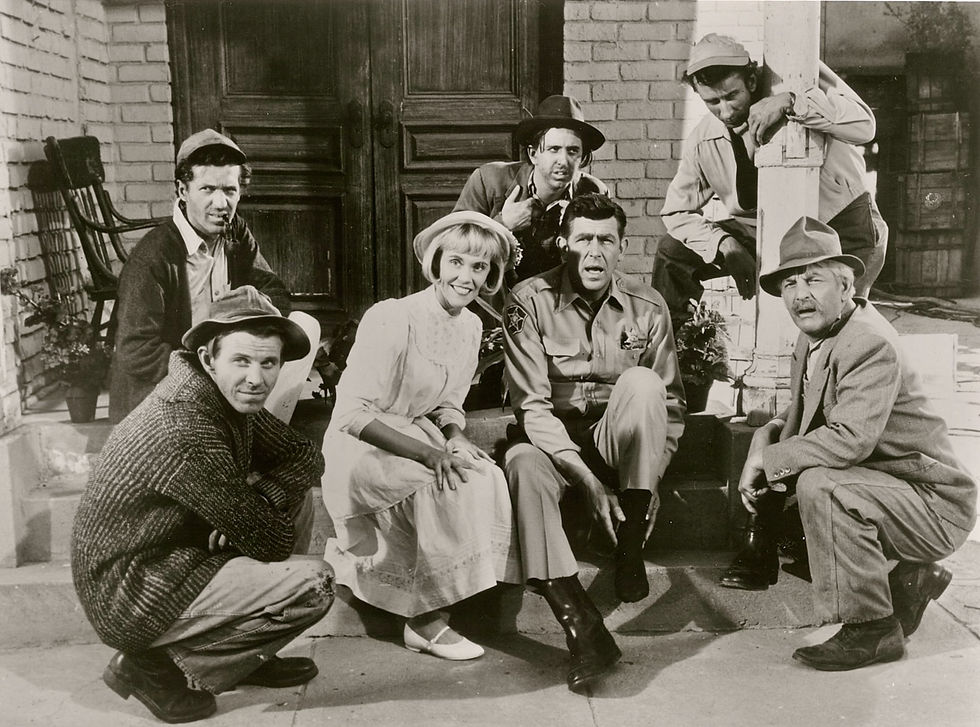
The show was fun. Everything was fun. Andy would pick his guitar. He loved playing. I’ll tell you a little story. One time (in the episode, Divorce, Mountain Style) we were getting ready to break into the sheriff’s office, and at that time Bob Denver, you know from Gilligan’s Island, was playing Dud Wash. And we were supposed to come in, pick him up and carry him out. So, we’re standing there waiting to go in, the director’s waiting, and Denver said, “You know, I wasn’t always an actor.”
I said, “What?”
He said, “No, I played drums for the Dorsey Brothers.”
This is now pacing.
He said, “I remember my first acting job with John Wayne.”
I said, “Yeah?”
He said, “Yeah. I was to come out on the front porch, look at John Wayne, point down the river from the cabin and say, ‘Look, fur smugglers!’”
This is all while we’re waiting for them to say “action,” right?
And then he said, “Yeah, I remember that morning. I ran out on the porch, the director said ‘action,’ I looked at John Wayne, and I pointed down this river, and I said, ‘Look, smur fugglers!”
And about that time, they said “action” to us. And we had to go in there and keep that stoic, deadpan face.
Did they tell you how you need to act on the show? I mean, did they coach you on how you were going to represent your characters, or was that mostly improvised?
Well, no, there was not a lot of coaching going on with us. We just did this look, and that was it, you know. But it really added a lot to what was happening. Well, “Darryl and my other brother Darryl” from the Newhart show, you know, that sprang off of that sort of thing. I couldn’t have imagined that deadpan look, the way they integrated it into the show, would work. But my goodness, it seemed to work.

The thing that really disrupted a whole scene one time was the snoring scene (in the episode, Mountain Wedding), when we were in the bed snoring, right? So, Denver (Pyle) and all four of the boys were there, and so we starting doing it, and then Andy and Don would break up. Every time we’d start to snore it became a symphony, it really did. You know, it was like a string quartet snoring, and we’d all try to outdo each other. Denver would start it, and Andy and Don could not keep it together.
Finally, the assistant director said, “OK, this is running slow, we’re losing money here. We gotta get this shot. Let’s be professional and do it.” He said, “action” and we started again, and all of a sudden he went. He lost it. And then he said, “OK, let’s break for lunch.”
Having the opportunity to showcase your original songs on the show. Was that something pushed by the group, or was it just a natural development?
Andy did a really nice thing for us. He was very good to us. He gathered us together once and he said, “Now boys, you’re not going to make any money as actors.” Because at the time, they weren’t paying residuals. And he said, “I’ll get all the songs of yours that I can on the show. You write them and we’ll put them on. We’ll do them.”
Well, for people who understand the publishing and ASCAP (American Society of Composers and Publishers) and BMI (Broadcast Music Inc., a Performing Rights Organization), they pay for it in perpetuity. So, every time the show ran, we made a little money. Andy did us such a great favor by doing that.
Did Andy talk about his roots in North Carolina with you? Kind of informally, off-screen, off-stage? Did he talk about where he came from?
He would tell about an uncle who would sit on the porch and say, “Lordy, lordy, lordy, lordy.” And maybe an hour later he’d sit there and say, “Lordy, Lordy, I wonder what the poor folks are doing.”
Andy told us how one time he went home after the show started, and he was talking to one of his uncles or somebody in his family. And that person said, “I see you there for a half hour every week.” Andy said, “Yeah.” And the relative said, “What do you do the rest of the time?”
You’ve commented over the years about various portrayals of rural people in the entertainment business, such as the characters on The Andy Griffith Show. Can you elaborate on those concepts and how that played out and maybe influenced you as you went on with your music?
Well, it did. I grew up watching people make fun of rural people, you know, putting that hillbilly pointy hat on their head, and drinking out of a jug, and chasing their sisters and, you know, that sort of thing. The Judy Canova period, when hillbillies were treated like idiots. But there’s such a value system among rural people, and a work ethic, like anywhere else. It’s a human condition. There’s a dark side of everything.
But, you know, (as entertainers) we kept our integrity. We walked out of shows. There was a couple of times when they put up the hay bales and put freckles on the dancers and dressed them up like Daisy Mae, and then we’d walk out and say, “I’m not gonna do this.”
You live in Branson, Missouri, and we’re near Pigeon Forge, Tennessee. They are similar destinations that feature family-friendly music theaters with dinner shows and other tourist attractions. With Pigeon Forge, there’s a little bit of debate about the authenticity of some of those representations of Appalachian culture. Do you sense that the Ozark culture is in any way misrepresented there in Branson, or have they done a respectful job of balancing the local and regional culture with the more national culture that’s there?
Well, that’s a complicated question. It’s hard to answer with just yes or no. I live in Branson because the farm, which is still in the family since 1865, is only two hours away. I came up here to Branson to raise my kids and get off the road. I gave up a lot to just come up here, but fortunately I was able to put together a show at Silver Dollar City, thanks to Jack Herschend.
(Herschend Family Entertainment, or simply Herschend, owns Silver Dollar City theme park in Branson, and co-owns, with Dolly Parton, the Dollywood theme park and several music and dinner theaters in Pigeon Forge, Tennessee, as well as several other theme parks and tourist destinations nationally.)
We had that show for several years, and I was trying to bring the traditional music to people who maybe — you know, there are people who are not really fond of bluegrass or mountain music. So, you have to try to bring that tradition to them and show them that it has value.
Not like Al Capp did with Dogpatch (the fictional setting for the comic strip Li’l Abner, which depicted the town as impoverished and backward.) And, of course, Beverly, who is from Western North Carolina and grew up learning banjo from (legendary fiddler, banjo player, and singer) Tommy Jarrell, is part of that. So, we started bringing that tradition back into the whole thing.
I hope I’m answering your question without being negative about Branson. Branson is a different paradigm than it was when I first came here 40 years ago. But things do change, and unfortunately in that change we seem to lose something in the spiral. I guess with progress, you’re going to lose some tradition, right?
Speaking of tradition and legacy: As leader of The Dillards, you have such a long and influential legacy in the recording industry, and also such a history of recognition for and celebration of the work with The Andy Griffith Show. You don’t seem to have a conflict between The Andy Griffith Show legacy and your own musical legacy. It seems like they’re kind of in partnership even.

That’s very interesting that you bring that up. I always look at our career as being schizophrenic. We were the Darlings, and then we were The Dillards — who, I’m learning after all these years, actually had some impact, you know, with the (International Bluegrass Music) Hall of Fame thing, and what different folks have said about us. But I’m very pleased with the fact that people remember The Andy Griffith Show, because to me that show represented something. Traditional family values, you know, held fast on that show. And those kinds of things, it seems to me, we might be slipping away from.
We went from that to opening for Elton John. And there’s all of those guys with groups like Led Zeppelin and The Eagles that we had some effect on. Sometimes it’s luck and where you are. I never realized until later on in life how important and how ordained that was for me to be a small part of something that had such an effect, and which enabled me to go out and meet so many people.
Ted Olson is a music historian and a professor of Appalachian Studies and Bluegrass, Old-Time and Roots Music at East Tennessee State University.
Mark Rutledge, managing editor of Appalachian Places, contributed to this story.


Comments